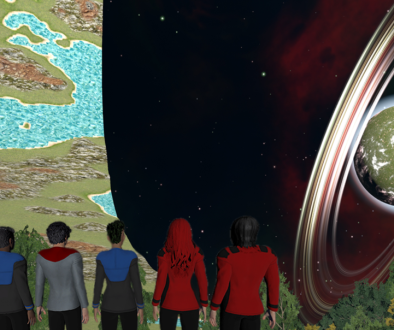
P-0: Virtual World: Project Goals
I have been thinking about the scope and the primary goals of my virtual world project. The primary aim is to create a world of unparalled realism, but I am divided as to how to do this.
I think this is the same problem that I had some years ago when I was working on Artificial Intelligence. Back then, I divided AI into two categories: Top Down, and Bottom Up. The top down approach to AI was to begin with the final evolution of the AI entity. This includes, for example, AI chat programs, AI learning agents, and various other programs designed to interact with humans. These programs are usually trained to “understand” or at least to utilise human-level language and communication “skills”. They may be programmed with a Logicial Inference Engine (Which several of my AI programs were) or they may be trained to understand adjectives, nouns, questions, etc etc.
However, humans didn’t always have language, and we aren’t born with it, hence the term “Top Down”.
I would define a “Bottom Up” AI program as being an emergent entity which is programmed with behaviours and goals. This type of approach would be used a lot in pathfinding, navigation, searching, and general problem solving. In a very simple case, and AI might be given a goal to reach a location in the fewest steps, and it’s behaviours might simply be “move left” “move right” etc etc. The AI must then “learn” how to navigate in the most efficient manner possible.
I can apply these two terms to virtual worlds as well. I think a Top Down Virtual world would begin with a setting, (The year 2100, medieval times, a distant planet, etc) and with a predefined history and set of rules. The user will then be given significant agency within that world to make their mark and explore, interact, and build. Most virtual worlds seem to take this form, at least to some extent.
A bottom up approach to virtual world design would be more unique. This would be where the world is not defined at all, there are no presets or rules (or very few, at least) and there is no rich backstory or history. The players are given a set of tools and abilties, and the idea is that the structure of the world evolves over time. This is the essence, I suppose, of the “sandbox” game. There have been games that have done this, but it is rare, and in many cases, when communities evolve, is has been unintentional. Players have had to fight with the existing structure of the game in order to form their communities or play the way they want to play, since the game wasn’t designed like that.
I think the idea of emergent virtual world games is very interesting, and that is the kind of direction I would like to proceed in. That is why I am modelling the world as a series of discrete elements, from flora and fauna, to raw materials, tools, and weapons. The players will be able to build everything in the world from scratch, including the invisible fabric of the world itself, the political system, the communities, the governments, the towns and villages. Players may decide to survive alone, or band together, they may choose to trade, they may choose to form groups with a hierarchy and a leader. It is one great experiment, and it remains to be seen how it will all turn out.
![Spiritus Astrum [P0-EA1]: p1673: Early Access](https://i.imgur.com/FDjragY.jpeg "Spiritus Astrum [P0-EA1]: p1673: Early Access")
![Spiritus Astrum [P0-EA1]: p1672: Early Access](https://i.imgur.com/waMgAov.jpeg "Spiritus Astrum [P0-EA1]: p1672: Early Access")