The Top 20 Games Of All Time: Part 2
As an avid, life-long gamer, I decided to honour my hobby by creating a list of my all time favourite games. Originally, the list was supposed to be a top-10, but I simply couldn’t pick just 10, there are too many games that needed to be on the list.
So, I cheated a little, and picked the top 20.
I am a little disappointed that there are no truly surprising entries on this list. Most of my favourite games are games that were widely recognised at the time as being exceptional, winning multiple awards, and earning their place in gaming history.
However, the titles span decades of gaming and many genres, and showcases some of the best titles of their respective decades.
I am well aware that there are many games that deserve to be on this list but aren’t, however, I am only including games that I personally played and have fond memories of, if I haven’t played a game myself, it won’t make the list. Halo, for example, certainly would get a place on this list, but my first experience with it was very recently when I played the Master Chief Collection on PC, so it doesn’t get an entry.
All images are considered to be “fair use” and are property of their respective owners.
10: Duke Nukem 3D
1996: 3D Realms / FormGen
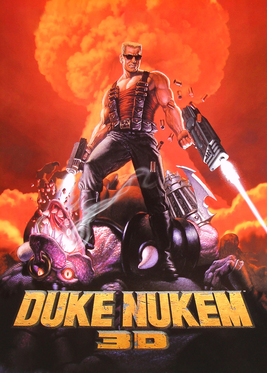
“Always Bet on Duke”
Nothing defines 90’s gaming culture more than Duke Nukem 3D. It’s violent, crude, offensive, in your face, and it doesn’t care.
Its graphics were powerful for its time: Combining 3D backgrounds with 2D sprites for enemies and weapons resulted in a game that felt like an immersive 3D shooter but had the performance to run on the limited hardware of the day.
The infamous Duke himself became more infamous than the game, and Duke Nukem, along with games like Carmageddon and Blood, often found themselves the object of controversy before GTA ever burst onto the scene.
However, unlike a lot of similar titles, Duke Nukem’s fame is earned, and not just derived from shock value alone. It’s gameplay is solid, with top notch graphics and sound. Enemies are powerful, and the player’s weapons even more so. The RPG, Devastator, Shrink Ray, and Ripper Chaingun eviscerate the games many enemies, often tearing them apart (Called “gibbing”).
Technically, it is an achievement, with complex effects such as remote cameras, and real-time modification of the level geometry.
Duke Nukem 3D also features one of the most memorable theme song in video gaming history “Grabbag” by Lee Jackson, as well as fully voiced one liners by the great Jon St John.
Duke Nukem 3D defines an era of gaming that is lost forever, but man, was it ever fun while it lasted.
9: Deus Ex
2000: Ion Storm / Eidos Interactive
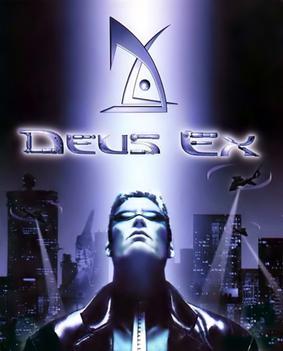
An epic sci fi adventure that asks the question: What if all of the conspiracy theories you heard were true?
The player is JC Denton a “nano-augmented agent” or “Nano-Aug”, working for a government agency called UNATCO, tasked with defeating the terrorist organisation known as the NSF.
Along the way, the player will travel the world and meet many strange and well-crafted characters, uncovering a vast conspiracy that will make even the most skeptical of players don their tinfoil hat.
Much more than just a shooter, charging into a room all guns blazing will likely get you killed here. Deus Ex is a first person RPG, allowing the player to spend points as well as find upgrade canisters to improve their skills in certain areas, from combat, to special abilities, to computer hacking.
If your skills are good enough, you can hack into computer terminals and disable security cameras, or even turn gun turrets against your enemies, clearing a room without ever firing a shot.
The level design also offers a varied and infinitely replayable experience: There are many ways to approach each objective, from direct assault, to stealth, along with many hidden items and weapons that can easily be missed on a casual playthrough.
The game features extensive dialog and a complex branching storyline where choices matter: in many cases, the player’s actions and choices change how NPCs react to you, as well as influence whether important characters live or die in a way that is fundamental to the game’s plot.
Deus Ex features a beautifully crafted world that feels real, with everything from the food and drink items that the player can pick up to the texture and environment art fitting the dark sci-fi aesthetic.
Modern adaptations of the series, such as Eidos’s Human Revolution and Mankind Divided, while exceptionally good games, don’t quite match the sheer scope and impact of the original.
8: FEAR
2005: Monolith Productions / Vivendi Universal Games
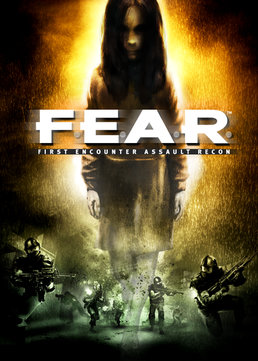
Very few games have the ability to make a player truly afraid of a little girl, but 2005’s FEAR is that game.
FEAR’s horror relies on much more than simple jump scares. It’s dark, foreboding atmosphere combined with an adult-oriented and, at times, quite macabre story set the scene for one of the most frightening games of all time.
The player plays as an unnamed “Point man” for First Encounter Assault Recon, a team sent in to investigate reports of paranormal occurrences in the fictional city of Fairport.
Along the way they meet Alma, a mysterious and terrifying young girl with psychic powers and a secret past.
Well crafted visual storytelling and Did-Something-Just-Move moments create a powerful sense of suspense and apprehension that makes the horror moments even more frightening when they appear.
Not only that, but FEAR’s combat system is extremely strong, with not only a slow motion ability but smart and aggressive AI that actively hunt the player. Enemies will communicate with each other, flank around the player to attack from unexpected angles, and throw grenades. Enemies can even spot the player’s flashlight, alerting them to the Point Man’s presence.
This also makes each of the games many gun battles feel unique: Every fight plays out differently, depending on the player’s weapons and tactics. Get in close and gib enemies with the shotgun, or remain at a distance and pin them to a wall with a nailgun, the choice is yours.
FEAR’s graphics and special effects were state of the art for its time, and still hold up quite well today. The slow motion effects are some of the most fun elements of the game, and the violence, gore, and horror scenes are genuinely frightening and disturbing.
A shooter lives and dies by its weapon loadout, and FEAR does not disappoint. The old favourites are all there, duel-wielded pistols, shotguns, submachine guns, assault rifles, but there are also some more unique choices such as the awesome Particle Laser and the Repeating Cannon.
A must-play for any FPS or horror fan.
7: Rome: Total War
2004: Creative Assembly / Activision / Sega
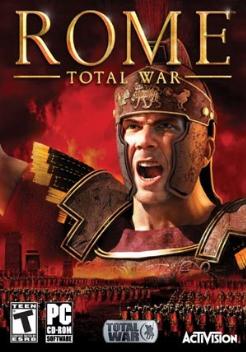
Rome was the first game that I sank over 100 hours into, trying to conquer the world as the house of Julii.
Technically innovative, Rome was one of the first games to allow the player to control truly massive armies of thousands of men, in full 3D and realtime, unlike other contemporary games that would max out at maybe a few hundred units on screen at the most.
Rome made the player feel like they were controlling a vast army, and allowed them to use real life tactics, terrain, and strategies in order to succeed.
In addition to the titular Romans, the game also features ancient powers such as the Carthaginians, Macedonians, and Greeks, all playable without additional payment, and most with their own unique unit roster, from Legionaires to War Elephants, Archers to Cavalry, and without a single micro-transaction or paid DLC in sight!
In addition to the advanced battle system, Rome also features a complex campaign map, where players must engage in diplomacy, trade, and politics as they defend, expand, and administer their vast and ever-growing empire.
Trying out all of the factions, units, and army types takes hundreds of hours, and there is enough depth in the gameplay for each of the major factions to feel truly unique, rather than a simple re-skin.
I have been a big fan of the Total War series ever since. Napoleon was fantastic, and the Warhammer Total War games were a breath of fresh air for the series, but it is the original Rome game that stands out as the defining entry in what became a successful franchise.
6: Max Payne
2001: Remedy Entertainment / Gathering of Developers / Rockstar Games
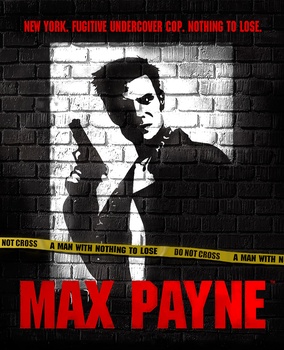
Max Payne is another masterpiece of gaming history that has it all: Great graphics, an emotionally powerful, well executed story, fun, addictive gameplay, and a unique, instantly recognisable personality all of its own.
The game is a dark, gritty, noir detective novel told in gameplay form. Its story takes the form of a comic strip, with voice-overs by the gravelly voiced protagonist as well as the games many interesting side characters.
Probably its most famous gameplay mechanic is “bullet time”. Max Payne was one of the first video games to implement this mechanic after the Movie “The Matrix” popularised the concept, and it uses it flawlessly: players can dodge, shoot, and move, in slow-motion, clearing entire rooms of enemies before they even have a chance to draw their weapons.
Max Payne’s story is above and beyond for a simple shooter, and still stands out two decades later. Following the titular character’s discovery of his family murdered by a gang high on the effects of a new drug called “Valkyr”, he embarks on a quest for revenge. The game heavily leans into Norse mythology, combining it with gritty modern reality with a dark, depressing, somber tone that leaves its mark long after you stop playing.
The game’s sound effects, music, and voice acting add to the mood and complete the package. Max Payne is one of the titles that prove that the gaming industry is capable of producing powerful, adult-oriented stories, not just mindless shooters.
Max Payne 2 deserves a mention here as well, as being one of the few sequels that live up to the original, and both of these games are very playable today.
5: Command and Conquer: Tiberian Sun
1999: Westwood Studios / Electronic Arts
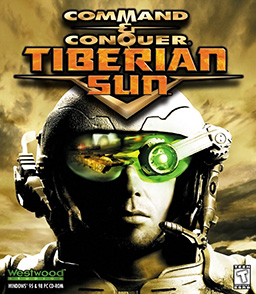
A real-time strategy game by the renowned Westwood studios, Tiberian Sun is the second game in the Command and Conquer “Tiberium” saga, continuing the war between the GDI and the Brotherhood of Nod, led by the mysterious Kane.
Tiberian Sun features a stronger story, deeper world building and atmosphere, and a quasi-dystopian sci-fi setting that differentiates from 2000’s Red Alert 2.
The game features stellar sprite-based graphics, a strong sci-fi story, and unique units and missions.
Playing as the GDI and Nod feels completely different, with their unit rosters, while equally powerful, having completely different playstyles.
Maps are large and battles long, meaning tactics matter: Destroying bridges can cut off enemy reinforcements, and managing your Tiberium resources is vital.
The gameplay in Tiberian Sun is simple: Left click select right click move, but it feels solid and satisfying, the game can be complex, but the controls are effortless.
The game features good pacing, with missions not feeling too easy or too difficult, and new units being unlocked often enough to prevent gameplay getting stale but not so often as to be overwhelming.
Like Red Alert 2, Tiberian Sun boasted an engaging story told in the form of quite high-quality FMVs. The cast features recognisable Hollywood names, including James Earl Jones, and Michael Biehn with Joseph D. Kucan returning as Kane.
The story combines a futuristic sci-fi theme with references to terrorism, resource shortages and environmental disasters.
Tiberian Sun’s soundtrack, while possibly not quite as memorable as Red Alert’s, was much better than the vast majority of games of this time, and even today, which makes sense considering the awesome Frank Klepacki worked on both.
4: Command and Conquer: Red Alert 2
2000: Westwood Pacific / EA Games
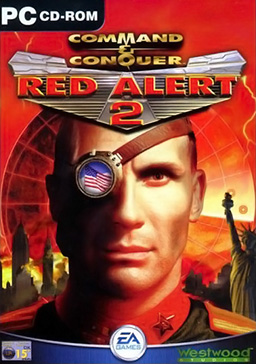
The best real-time strategy of all time, by the unforgettable Westwood studios. I debated with myself as to whether to include Tiberian Sun first on this list, or Red Alert 2. Both are spectacular games, going above and beyond with their addictive gameplay, great graphics, and immersive FMV sequences.
I chose Red Alert 2 first simply because it was the game that I remember playing the most out of the two. While Tiberian Sun’s story might be slightly stronger, Red Alert 2 has the superior gameplay and playability.
The game features two fully featured campaigns: Allied and Soviet, and tells the story of an alternate reality where the Soviet Union has launched an attack on the United States, which the player must either defeat, or finish.
One of the most striking elements of Red Alert 2 is how smooth and satisfying the gameplay is. Movement and combat feel effortless, units are both unique and well-balanced, both within each faction, and between both factions. Units such as the Kirov Airship, Agent Tanya, Chronosphere and Prism Towers are all memorable fan favourites. The sprite animations and sounds are well designed, and integrate seamlessly with the action, with buildings becoming damaged and destroyed, soldiers being killed, and tanks blowing up with satisfying results.
Gameplay is simple, but challenging: players must use strategy and tactics, develop a plan and carry it through. However at the same time, this is not a “simulation” title, it is easy to pick up and play, and you could “tank rush” through most of the levels if you really wanted to.
Like its brother Tiberian Sun, Red Alert’s story is told through live-action FMVs featuring professional actors, such as the gorgeous Kari Wuhrer playing agent Tanya, and Barry Corbin playing General Carville.
Red Alert 2 takes its story somewhat seriously, which, despite its obviously fantastical nature, adds a great deal of immersion and depth to the game, which I like.
The third installment in the franchise, while not a bad game in terms of its core mechanics, descends too much into the realms of slapstick with its story, which I didn’t enjoy quite as much.
One final point is the soundtrack. Frank Klepacki created one of the finest video game soundtracks of all time, including the incredible “Hell march 2”, which , along with Duke Nukem’s “grabbag” is one of the all-time greatest video game hits.
3: UFO: Enemy Unknown / X-COM: UFO Defence
1994: Mythos Games / MicroProse
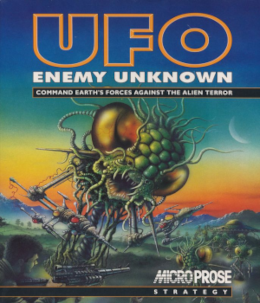
The greatest turn-based tactics game of all time, X-COM inspired an entire genre that still exists today. However, despite significant technical advances in the intervening years, none of the recent entries in the series have replicated the depth, replayability, and sheer scope of the original.
1994’s X-COM had the ability to build bases anywhere in the world, and customise their layout. It had a deep research tree. You could bring over a dozen soldiers on a mission, and equip them with any combination of weapons or gear. This lends itself to very powerful combinations. One soldier carries a rocket launcher while another carries ammo, so that you have plenty of time units to both move and shoot.. You can give a soldier nothing but a pistol, so they can scout and reveal enemies for your more heavily laden and slower soldiers.
Not only that, but X-COM features fully destructible terrain. Players can shoot holes in buildings to launch sneak attacks on enemies, or to evacuate if the mission is going badly. They can destroy fences, hedges and other obstacles to improve sightlines, and even demolish entire buildings to kill any enemies hiding inside!
While some of the modern X-COM and X-COM-like games are excellent (such as the Firaxis remakes), they still massively simplify the gameplay: No custom bases, only six soldiers per mission, loadouts limited by role, smaller map sizes, etc.
To this day, no mainstream title has replicated the sheer scope of what X-COM did. It is a genre-defining masterpiece that still holds up today, and is, as a game, almost perfect.
In my opinion, 2003’s UFO:Aftermath by Altar Interactive actually comes closest to capturing the magic of the original, but even this is vastly simplified. It is not a turn based game, and does not feature custom base building.
If I had to criticise X-COM, I would say that the psionic mechanic feels a little unfair. When enemies first start using psionic attacks, the player has no defence, meaning that you can suddenly find yourself losing half your soldiers through a random dice roll.
In addition, the game does feature frustrating searches for the last enemy on the map, called “last-bug hunts”.
However, the complexity and sheer power of the players choices makes the Original X-COM far superior to its more casual modern iterations.
X-COM is the kind of game that you can return to time and time again, and still discover new tactics, strategies, and playstyles.
2: Half Life 2
2004: Valve
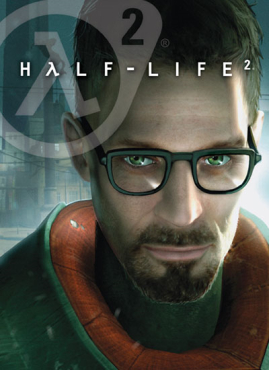
Well deserving of its place on the list, Half Life 2 is a masterpiece of engaging, emotional, immersive, storytelling within a world that feels real.
While the original game was a technological milestone well ahead of it’s time, Half Life 2 takes this to the next level. It features not only state of the art graphics, animations, and an innovative physics system (That even rivals many modern titles) but also a powerful story and memorable characters, such as Alyx and Eli Vance, and Dr Breen as well as the crowbar-wielding MIT-educated protagonist Gordon Freeman.
In addition to its physics, Half Life 2’s graphics were outstanding, with innovative facial animations, lighting, and special effects.
Half Life 2 was one of the rare games out there where you genuinely care about the characters, and want to be a part of the world. Half Life 2 is set some time after the events of the first Half Life, where Gordon Freeman emerges from stasis into a world occupied by the alien Combine and their human collaborator Dr Breen.
The game’s storytelling is excellent, and its pacing is well balanced between action-packed combat, story-rich dialogue, and immersive exploration, driving, and physics puzzles.
The final sequence of the game, where the player is leading the revolution against Dr Breen, is one of my favourite moments in video gaming history. The world is so deep and believable that by this stage of the game the player feels genuine anger at the plight of the people of City 17, and is determined to help them earn their freedom.
There were times while playing this final battle sequence where I reloaded just to save random NPCs in the world. Not because they were important for the story, but because I couldn’t bear having them get killed.
The story features subtle but powerful moments (Such as the resistance tearing down monitors displaying images of Dr Breen) and lines of dialog such as “Now that you’re here, we’ve got a chance” that reinforce the player’s role as the saviour of this world and these people. You feel important, you feel like the world needs you.
That kind of immersion and genuine empathy for fictional characters is as rare today as it was then.
1: Witcher 3: Wild Hunt
2015: CD Projekt Red / CD Projekt
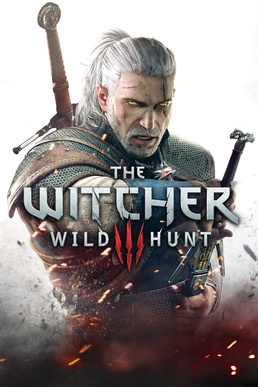
At the top of the list is what I believe to be the greatest game ever made. Its story, gameplay, world-building, characters, graphics, sound design, and immersion are the best I have ever seen in a game.
The sheer depth and care taken to bring the world of Sapkowski’s The Witcher novels to life results in a masterpiece of a game that can be replayed over and over again with new content still being discovered on each playthrough.
Tremendous voice acting, hundreds of quests, excellent music, hundreds of weapons, armour types, items, and equippable items, dozens of memorable, fully voiced characters (My favourite being Triss Merigold, voiced by Jaimi Barbakoff, and of course Geralt himself, voiced by Doug Cockle) and unique enemies (Such as the Leshen) make the Witcher 3 the kind of game that will simply never be beaten.
What makes the Witcher so great? Games like The Elder Scrolls: Skyrim offer more agency and customisability over your build, which I typically prefer over the more lore-focused Geralt of Rivia with his two swords and more limited magic abilities.
But that’s what sets the Witcher 3 apart from other RPGs. You are not simply playing a game, you are visiting a world. This is what gaming has always been for me: A journey, or even an escape, from one world into the next.
The Witcher offers hundreds of hours of gameplay within a story and character rich world. Each of the game’s side quests could be an entire story in itself, while the main quest features romance, humour, despair, and loss.
Other games may offer the player more agency, but in so doing they lose a lot of the depth and immersion that sets the Witcher apart.
The Witcher’s combat system is simple but satisfying, and even though Geralt prefers carrying two swords to a more varied combination of weapons, there are plenty of unique choices to keep your inventory stocked.
If I had to criticise the game, I would say that the combat system could be developed further. Once you have mastered the attack-attack-roll combo, even higher difficulties become a breeze.
More important than this is that the Witcher’s extensive crafting system (From Witcher Gear to Oils) is not important enough in the game. Players will find better gear in the world or from quest rewards, making the items that you have spent time crafting obsolete far too quickly. Oils do make fights shorter, but for most encounters they aren’t really needed. I have gone through entire playthroughs, even at higher difficulties, without ever crafting an item or using an oil on my blade. Finally, some of the quest rewards are worthless the instant you receive them (Such as the famous “Blade from the Bits” sword that you get from Hattori), although this is a common balancing issue in a lot of RPGs.
The Witcher is the kind of game you can get lost for hours in, just wandering from town to town, doing a quest here, talking to a character there, or just exploring, not to mention playing Gwent, the collectible card game that is additively fun once you get the hang of it!
Personally, I love the world so much that I don’t use fast travel (except between maps) or travel by horse. I prefer to walk, to drink in the atmosphere of the game. It is a role-playing experience, wandering from town to town, picking up contracts, talking to the locals, visiting the local taverns. I can’t even remember the number of times I have watched the sun set over the Novigrad docks, or wandered through the swamps of Velen at night with a torch in my hand.
With the Witcher, the player is a part of the world, but it doesn’t revolve around them. When you stop playing, it feels like the world is still there, that it is real, in a way. The Skelligers are still raiding the coast, Emperor var Emreis is still scheming to conquer the land, and Geralt, Triss, Yen, and Zoltan are still travelling the land, with many adventures still to be had.
The Witcher is a masterpiece that is unlikely ever to be bested, it just got it right in a way that nothing else can. There have been games out there that might have better graphics, more weapons and abilities, and maybe even better gameplay in some respects, but those are games.
The Witcher is a world.
Famed film critic Roger Ebert once said that “Video games can never be art”. I have always believed that he was wrong. Not only can video gaming be equivalent to other forms of art, they can, at least in theory, surpass them. Most art forms are passive: You watch a movie, listen to a song, look at a painting. Only gaming allows you to interact with the artform, be a part of it, experience it as you choose.
Even games that don’t offer branching story paths still allow the player to choose how they play: Which weapon to equip, which enemy to fight first, which room to enter, etc. This means that gaming can involve its audience in a way that no other artwork can.
In some ways, I believe that gaming has started to lose its way. Today, it seems the gaming industry is just that: an industry, dominated by predatory mechanics, micro-transactions, excessive politicising and censorship. However, the potential today is even greater than it ever has been. I wanted this list to be a celebration of my life with gaming, and I think it has been.
I have been lucky enough to enjoy what I believe to be the peak of gaming, a time when gaming was fun and free. I can only hope that some day we can rediscover the joy and passion that used to be the driving force behind the games we play.